ARTICLE 01 · 12 MIN READ
When Does Your Business Need Custom AI Development?
Choosing between an off-the-shelf tool, a focused API integration, and full custom AI development comes down to your actual requirements, the limitations you run into, and what each option costs to maintain over time.
For many businesses, an existing AI tool already solves the problem reliably — in that case, use it. If a focused API integration can automate the workflow, build the integration. Custom AI development starts making sense when your data, workflows, integrations, product requirements, or business logic create needs that off-the-shelf tools cannot satisfy.
The real question isn't: "How can we use AI?"
It's: "Does this problem justify building a custom AI system?"
What Is Custom AI Development?
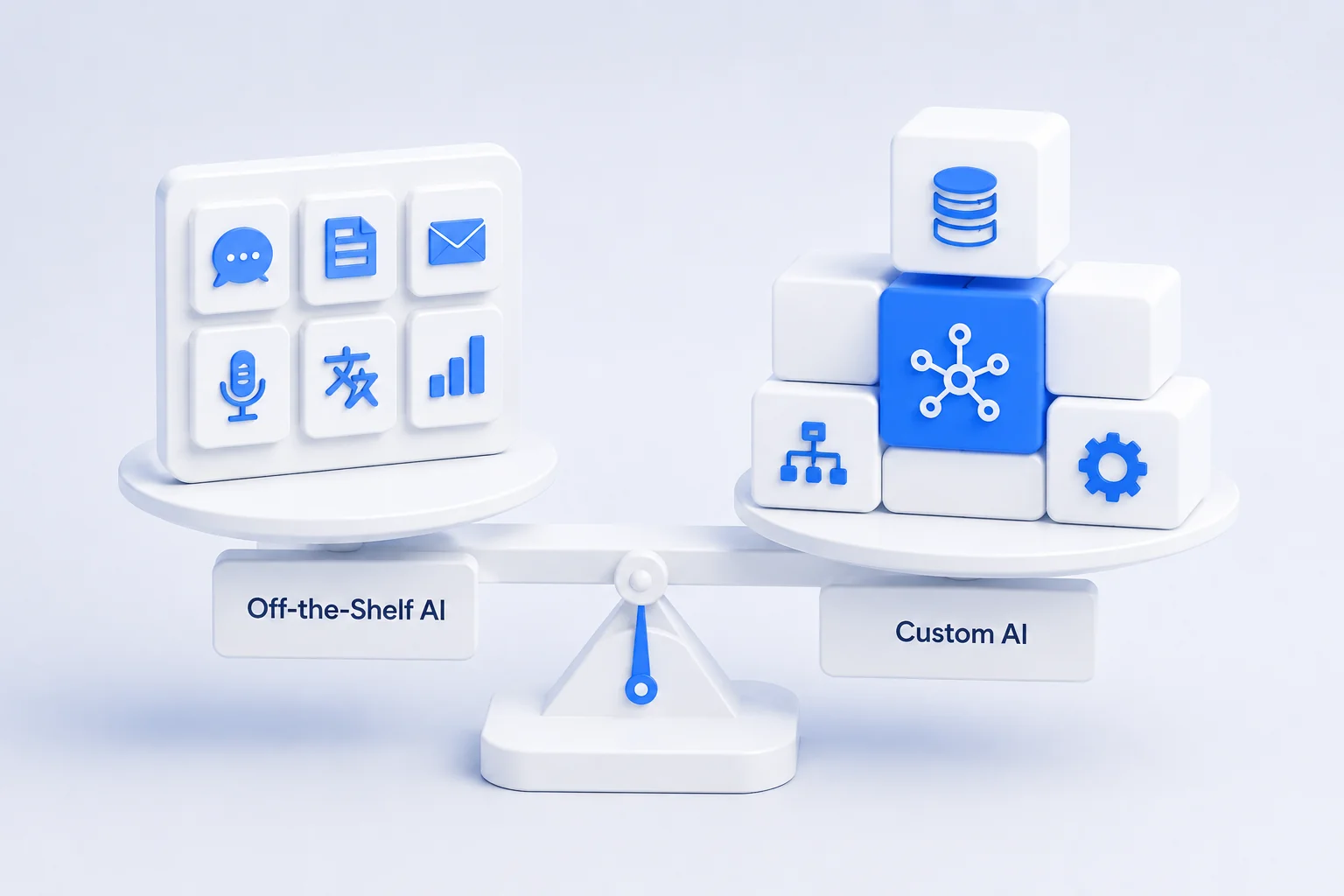
Custom AI development means building an AI-powered system around the specific requirements of a business instead of adapting the business to a generic AI product.
The difference is important. An off-the-shelf AI tool is designed to work reasonably well for thousands or millions of users. A custom AI solution can be designed around your data, your workflows, your existing software, your customers, your business rules, and your operational constraints.
That doesn't necessarily mean training an AI model from scratch. In fact, most businesses don't need to. Modern custom AI applications can combine existing foundation models with proprietary data, APIs, retrieval systems, business logic, automation, and purpose-built software. The value often comes from how the system is engineered around the model, not from creating a new model.
It's also worth being clear that a focused API integration and a full custom AI system don't have a hard boundary between them. Both connect a business to a model. What separates them is the scope of engineering involved, how much control the business has over behavior and data access, and who is responsible for keeping the system running as requirements change.
Custom AI vs Off-the-Shelf AI: Build, Buy, or Integrate?
Before deciding to build, it helps to compare the three realistic paths side by side. None of them is universally cheaper, faster, or safer — the right choice depends on your specific constraints.
| Criteria | Off-the-shelf AI tools | Focused AI API integration | Custom AI system |
|---|---|---|---|
| Best suited for | Common, well-defined tasks like writing, summarizing, or transcription where your process can adapt to the tool | One clear action inside an existing app, such as classifying or generating a specific piece of content | Problems with unique workflows, proprietary data, or multiple connected systems |
| Fit with business processes | You generally adapt your process to the tool's design | The integration is shaped around one existing process, not the whole workflow | The system can be shaped around your process, approval rules, and exceptions |
| Access to data and systems | Access depends on the product's supported connectors, APIs, permissions, and plan limitations | Access is scoped to the workflow and may involve one or more systems or data sources | Can be designed to reach multiple internal systems, subject to what you choose to expose |
| Control and customization | Limited to the vendor's configuration options | Moderate — you control the prompt, inputs, and how the response is used | Highest — model choice, business logic, fallback behavior, and access rules are all yours to define |
| Upfront effort | Low; mainly evaluation and rollout | Moderate; scoped engineering work around one workflow | Higher; requires architecture, integration, and testing work before launch |
| Ongoing maintenance responsibility | Mostly the vendor's; you manage licensing and usage | Shared — the vendor maintains the model, you maintain the integration code | Yours — you own monitoring, updates, and keeping the system aligned with changing needs |
| Limitations and security considerations | Data may need to leave your environment under the vendor's terms; review their data-handling policy before relying on it for sensitive information | Security scope is narrower, but still depends on how credentials and data are handled in the integration code | Security is largely your responsibility to design correctly; more control does not automatically mean more secure — it means the safeguards are on you to build and maintain |
When You Probably Don't Need Custom AI
Before discussing when to build custom AI, let's eliminate several situations where you probably shouldn't.
An Existing Tool Already Solves the Problem. Suppose your team needs AI for writing emails, summarizing documents, transcribing meetings, generating marketing ideas, translating content, or basic data analysis. There are already excellent products for these tasks. Building custom software to reproduce functionality that can be purchased for a reasonable monthly subscription rarely makes financial sense. Use the existing tool and focus your engineering budget somewhere more valuable.
A Focused API Integration Is Enough. Sometimes you don't need an AI platform — you need a focused API integration. Imagine that your application receives customer feedback and you want AI to classify each message by category. You may only need: Application → API → AI Model → Structured Response. That's an AI integration, not necessarily a custom AI product. Good engineering is not about building the most sophisticated system. It's about building the simplest system that reliably solves the problem.
The Problem Isn't Clearly Defined. "We want to add AI to our business" is not a project specification. Before investing in custom AI development, you should be able to describe what process you are improving, who will use the system, what success looks like, and what happens if the AI makes a mistake. If those questions don't have clear answers yet, the right first step may be discovery or a small prototype — not full-scale development.
When Custom AI Development Does Make Sense
There are several situations where custom development becomes much more interesting. Having internal data or a need to connect several systems doesn't, by itself, prove that custom development is required — it's worth first checking what an off-the-shelf tool or a scoped integration can actually do before ruling it out.
1. Your Workflow Is Unique
Most businesses don't operate exactly like their competitors. They have internal processes, approval rules, exceptions, integrations, and domain-specific requirements. Generic AI tools usually understand the task. They don't necessarily understand the workflow around the task.
Imagine an AI system that processes incoming documents. Generating a summary might be easy. But your real workflow may require the system to identify the document type, extract specific information, validate it against internal records, detect missing information, route the document to the correct department, request human approval when confidence is low, update another system, and create an audit trail.
At that point, you're no longer buying an AI feature. You're engineering a business system. That's where custom AI becomes valuable.
2. AI Needs Access to Your Proprietary Data
Public AI models know a lot. They don't automatically know your business. They may not know your internal documentation, customer history, inventory, contracts, product catalog, operating procedures, or company knowledge.
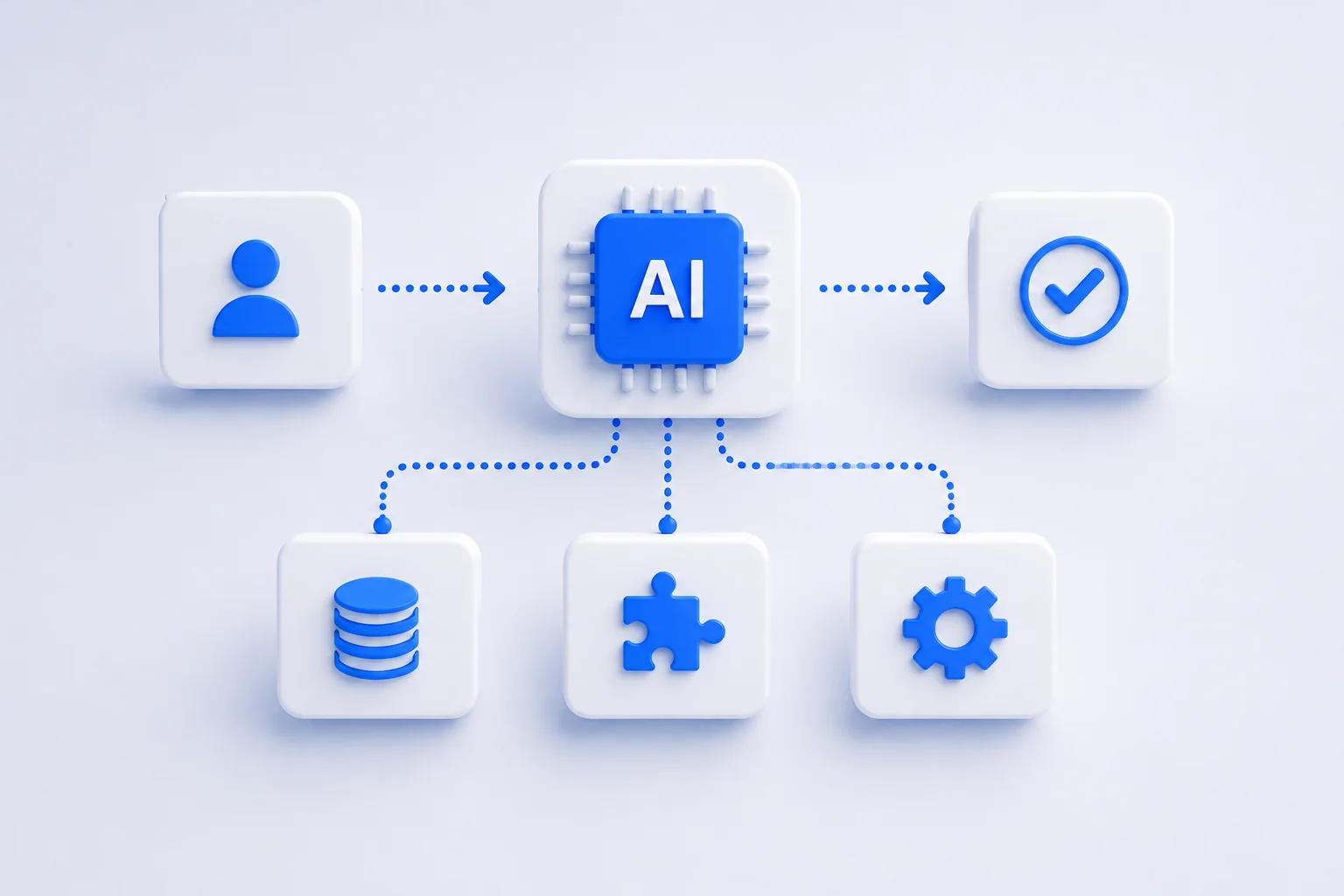
Before building custom infrastructure for this, it's worth checking whether an off-the-shelf tool with a connector or plugin for your data source already covers the need — some do. When it doesn't, a custom AI application can connect models to authorized internal information. For example: User Question → Permission Check → Knowledge Retrieval → AI Model → Answer. This type of architecture can power internal knowledge assistants, customer support systems, document intelligence platforms, and specialized research tools.
The difficult part isn't making the model generate an answer. The difficult part is retrieving the right information, for the right user, with the right permissions, at the right time — and getting any one of those wrong can matter more than how much of the broader problem the system otherwise covers.
3. AI Needs to Connect Multiple Systems
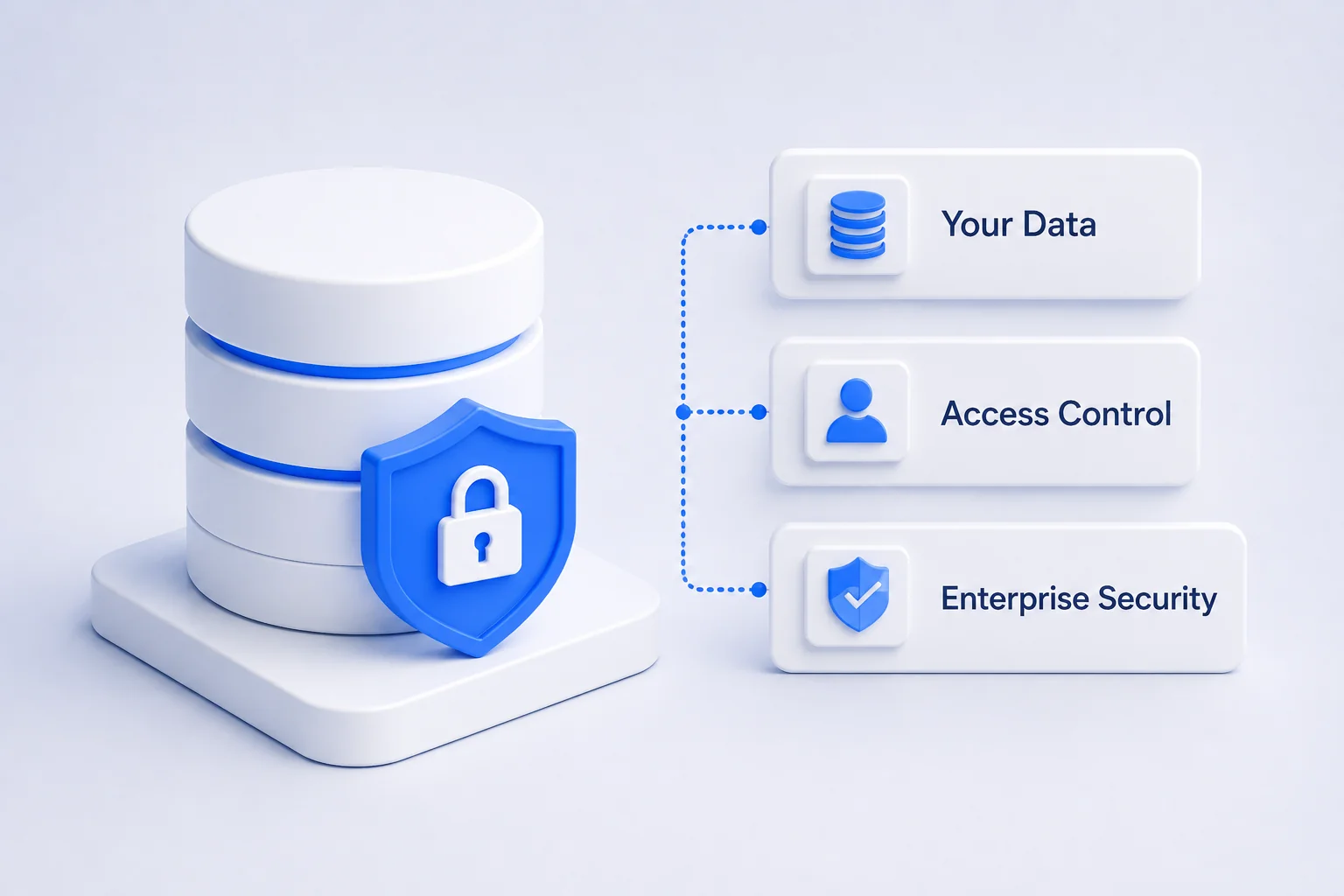
This is one of the strongest reasons to build custom AI software. Businesses rarely operate inside one application. They may use a CRM, ERP, accounting software, internal databases, communication platforms, payment systems, and industry-specific tools.
Now imagine an AI workflow that needs to receive a request, understand it, retrieve customer data, check another system, make a recommendation, update the CRM, and notify an employee. No standalone chatbot can magically understand how all those systems should interact. The AI needs an integration and orchestration layer around it. This is where API architecture becomes just as important as the AI model itself — see our guide to building an AI MVP for how to scope that layer without overbuilding it.
4. AI Is Part of Your Product
There is a major difference between using AI internally and selling a product powered by AI. If AI is part of the product your customers pay for, requirements change significantly. You need to think about authentication, permissions, reliability, latency, usage limits, billing, monitoring, model costs, scalability, error handling, and user experience.
A prototype connected directly to an AI API may be enough to validate an idea. It usually isn't enough to operate a production SaaS product. If AI is becoming part of your competitive advantage, owning the architecture becomes much more valuable.
5. You Need More Control
Generic AI platforms optimize for general use. Businesses sometimes need much tighter control over how AI behaves. For example: which models can process certain requests? What information can the model access? When should a human review the result? What happens when confidence is low? How much can each customer spend? What should happen if the primary AI provider becomes unavailable?
Custom AI development allows these decisions to become part of the application architecture rather than being dictated by the limitations of a third-party product.
Custom AI Doesn't Mean Building Everything From Scratch
This is one of the biggest misconceptions about custom AI development. A good engineering team doesn't rebuild technology that already exists. A custom AI system might use existing foundation models, cloud infrastructure, databases, vector databases, authentication providers, APIs, and open-source frameworks. The custom part is how those components are combined around your business.
Think of it like building a house. You don't manufacture your own windows, electrical cables, or concrete. You use proven components and engineer them into something designed for a specific purpose. Custom AI software works the same way.
Build vs Buy AI: A Practical Decision Checklist
Before investing in custom AI development, work through the following questions.
- Does an existing tool cover the requirements that actually matter? Broad coverage isn't enough on its own — a tool that handles most of the workflow but misses a critical requirement, such as permission control or output accuracy on edge cases, can still be the wrong fit.
- What are the data, access, and integration constraints? Map out which systems the AI needs to reach and what access controls are non-negotiable.
- Would a simpler solution or standard automation be enough? Not every workflow problem needs AI — some are solved more reliably with rules-based automation.
- How will output quality be measured? Define what "correct" looks like and how you'll check for it, before development starts.
- What happens when the AI is wrong, and when is human review required? Decide the error tolerance for the workflow and where a human needs to stay in the loop.
- Who owns ongoing maintenance? Custom systems need monitoring and updates after launch — someone has to be responsible for that.
- What is the total cost, including build, model usage, monitoring, and support? The cost of a custom system extends well past the initial build.
Applied to the document-processing example above, this means being specific about what "working" looks like: how long the system takes to process a document, how accurately it extracts the required fields, and what share of documents still need a human reviewer before anything ships to production. Those are the numbers worth tracking once the system is live — we're not publishing benchmark figures here because they depend entirely on your documents and workflow.
Start Smaller Than You Think
Even when custom AI makes sense, building the entire vision immediately usually doesn't. Start with the smallest workflow that can prove business value.
Instead of "Build an AI platform for our entire company," start with "Automate this one high-volume workflow and measure the result." The same logic applies if you're considering an autonomous AI agent: our guide to AI agents in production explains why a well-designed workflow is often the better first build.
A focused first version allows you to test the assumptions that matter: Does the AI perform well enough? Is the data good enough? Will employees actually use it? How much does each workflow cost? Where does human review remain necessary? Once those questions are answered with real usage data, expanding the system becomes much safer.
Choosing a Custom AI Development Company
If you decide to build, don't evaluate a development team only by which models or frameworks they use. Those technologies change constantly. Instead, look at whether the team understands:
Software engineering. Can they build reliable production applications?
API architecture. Can the AI integrate cleanly with your existing systems?
Data architecture. Can the system retrieve and process the right information?
Security. Can access to sensitive data be properly controlled?
Evaluation. Can AI quality be measured instead of judged subjectively?
Observability. Will you know what happens when something fails?
Cost engineering. Can the system remain economically viable as usage grows?
The model is only one component. The surrounding engineering determines whether the AI becomes a useful product or an expensive experiment.
Once you've decided custom development is the right path, the next question is almost always budget — see our breakdown of what custom AI development actually costs and what drives the price.
Conclusion
Custom AI isn't automatically better than off-the-shelf AI. It's simply a different tool. If an existing product solves your problem, use it. If a focused API integration is enough, keep the architecture simple.
But when AI needs to understand your proprietary data, operate inside unique workflows, integrate deeply with existing systems, or become part of your product, custom development can create something generic tools cannot.
The goal shouldn't be to build more AI. The goal should be to build the right system for the problem.
At Seawolf Intelligent Computing, we design and build production-grade AI software, APIs, and SaaS platforms around real business requirements. Have a workflow or product that might need custom AI? Discuss your AI workflow and we'll help you determine whether custom development is actually the right approach.
Frequently Asked Questions
How do I know if my business actually needs custom AI?
Start by asking whether an existing tool already covers the requirements that matter most — not just most of the workflow in general, but the specific parts that can't be compromised, such as permission control, data handling, or output accuracy on edge cases. If it does, use it. Custom AI makes sense when your data, workflows, or integrations are specific enough that generic tools can't meet those critical requirements — or when AI is becoming part of the product you sell.
Does custom AI development mean training a model from scratch?
Almost never. Most custom AI systems use existing foundation models and combine them with your proprietary data, business logic, and integration layer. The value comes from how the system is engineered around the model, not from building a new model. Training from scratch only makes sense for very specific domains with large, proprietary datasets.
How long does a custom AI project typically take?
Timelines depend on the workflow's complexity, how many systems it needs to connect to, how much of the required data is already accessible, and how strict the accuracy and review requirements are. A single, well-defined workflow with clean data access will move faster than one that spans multiple systems or has tight accuracy requirements. We recommend starting with the smallest slice that can prove real business value, then expanding from there — that scope is also what determines a realistic timeline.
What should I define before reaching out to a development team?
The more precisely you can describe the problem, the better. Useful inputs: what process you want to improve, who uses it, what a correct output looks like, what happens when the AI is wrong, and how you'll measure success. You don't need a complete specification — but having answers to these questions makes scoping conversations much more productive.
How is custom AI different from adding an AI API to an existing app?
There's no hard line between the two — both connect a business to a model. An API integration typically connects a model to one specific action in your product. Custom AI development usually means a larger scope: building the orchestration layer, data pipelines, validation logic, failure handling, and monitoring that make the model reliable across a broader workflow, along with taking on the ongoing responsibility of maintaining it. The model is one component. Everything around it — and who maintains it — is what defines the difference.