ARTICLE 02 · 13 MIN READ
How to Build an AI MVP Without Overengineering It
Most AI products should start smaller than their founders imagine. When you have a strong idea, it's tempting to think about the complete platform: AI agents, automation, analytics, integrations, custom infrastructure, and every feature users might eventually need. That's usually the wrong place to start.
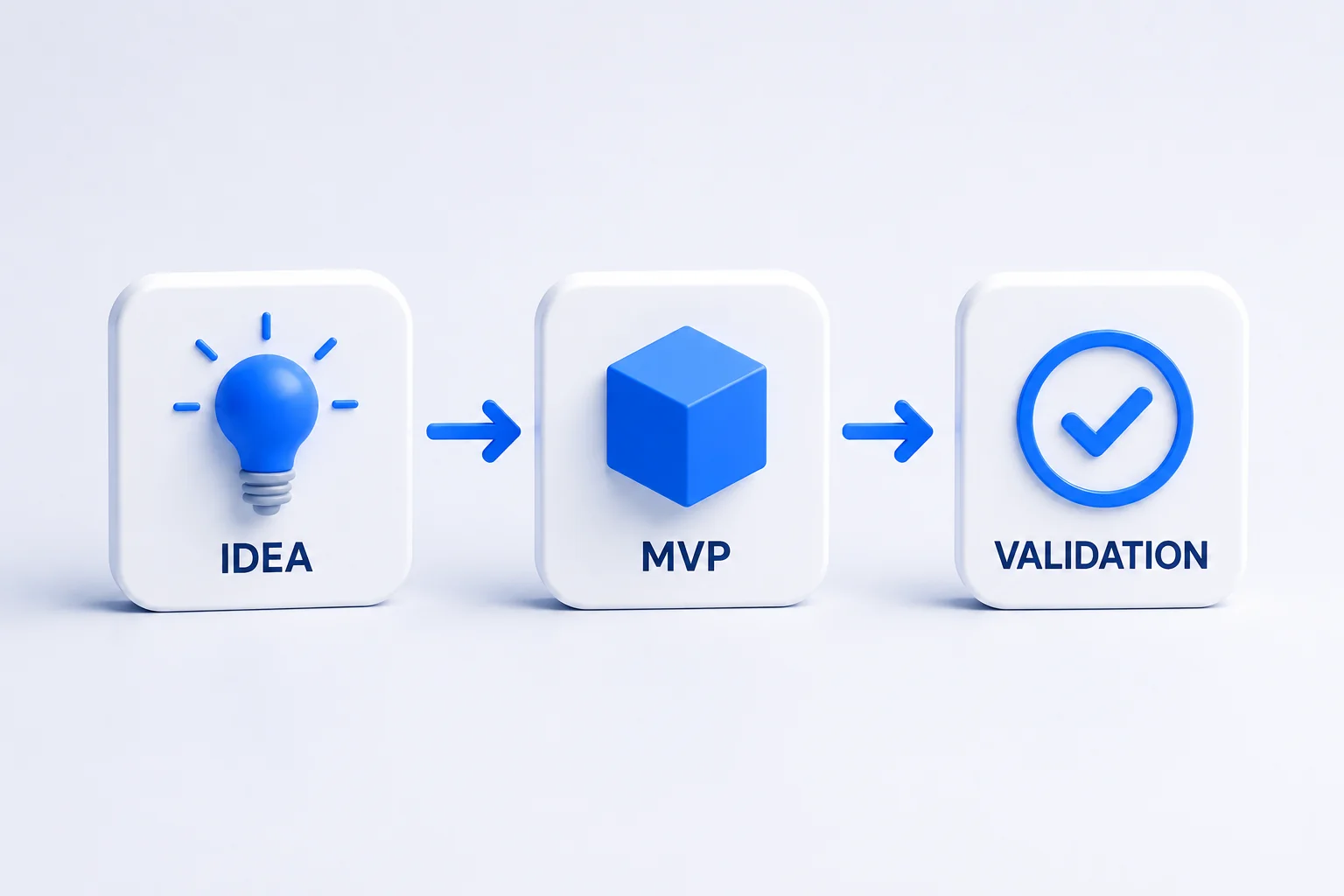
An AI MVP has one job: Test whether the core product creates enough value to justify further investment.
Build too much, and you spend months engineering assumptions that haven't been validated. Build too little, and you end up with a demo that works during a presentation but tells you almost nothing about how real users will interact with the product. A good AI MVP sits somewhere in between.
What Is an AI MVP?
An AI MVP — Minimum Viable Product — is the smallest functional version of an AI-powered product that can test its most important assumptions with real users. The key word is functional.
A prototype is built to test feasibility or one specific assumption — for example, whether a model can perform a task at all. An MVP is built to collect evidence from real usage and test whether the product creates enough value for people to keep using it. That evidence can come back positive or negative — an MVP that shows users don't want the product, or won't trust the output, has still done its job.
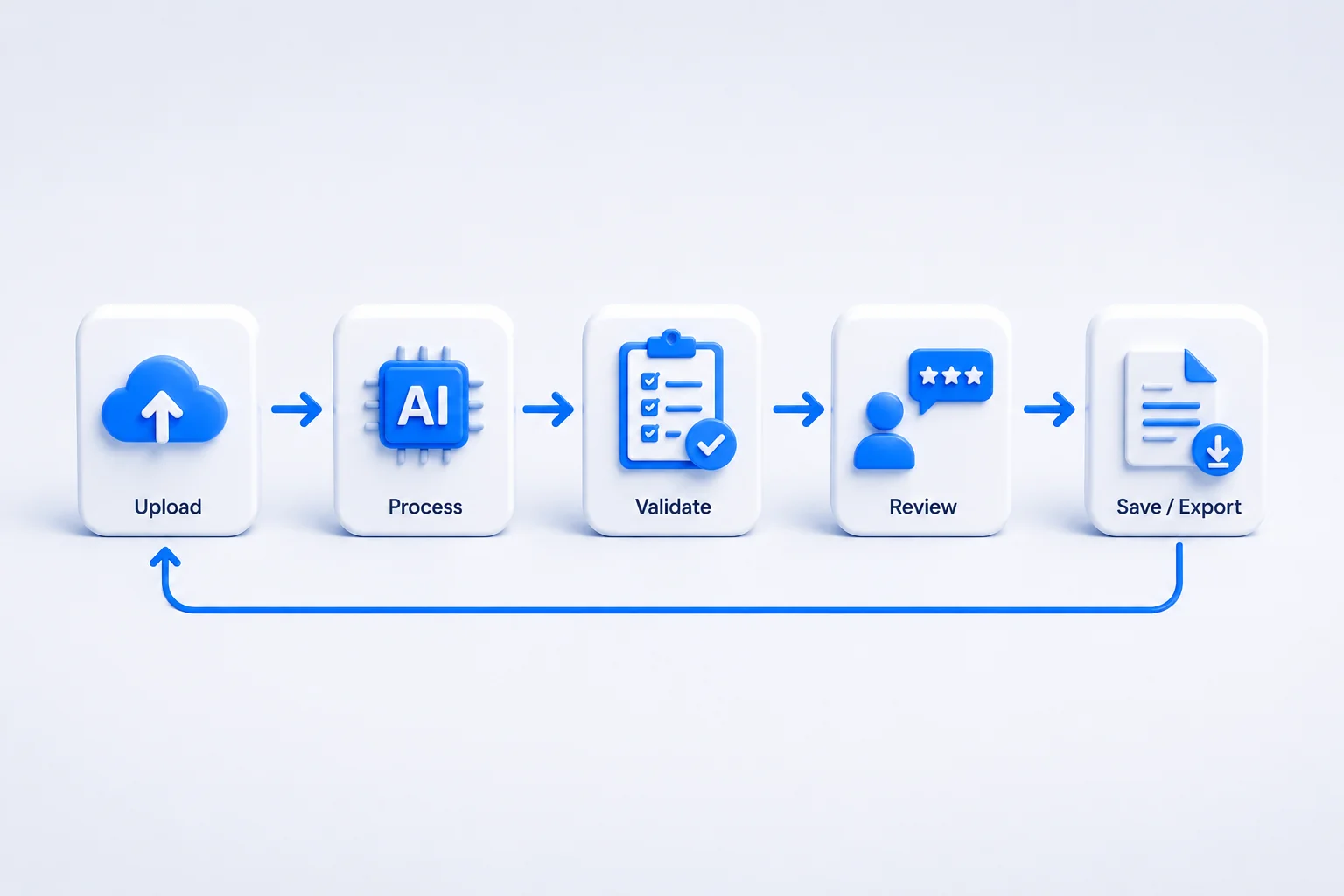
Imagine an AI document-processing product. A prototype might allow someone to upload a PDF and receive an AI-generated result. An MVP might support a complete workflow: Upload → Process → Validate → Review → Save. Whether it needs authentication, a database, or a full review interface depends on the workflow and the data involved — a low-stakes internal tool needs less scaffolding than one handling customer financial documents. It doesn't need every future feature. It needs enough product around the AI to test whether the idea creates real value.
AI Prototype vs AI MVP
The two are easy to conflate because both involve a working AI feature. What differs is the goal, who uses it, and what you can conclude from the result.
| Aspect | AI Prototype | AI MVP |
|---|---|---|
| Goal | Test feasibility — can the model do this at all? | Test product value — do real users get enough benefit to keep using it? |
| Users | Usually the team itself, or a handful of friendly testers | Real users from the target audience, using it for actual work |
| Scope | One narrow capability, often with sample or curated inputs | One complete workflow, end to end, on real inputs |
| How it's evaluated | Manual inspection of outputs against a small set of examples | Usage data, outcome metrics, and direct user feedback over time |
| What you learn | Whether the underlying capability is technically viable | Whether the product is worth continuing to build — a yes or a no |
In practice, most teams need both: a short prototype phase to de-risk feasibility, followed by an MVP that puts a complete workflow in front of real users.
The Seven Steps
The steps below organize the process end to end. Each one names what to do, what you should have when it's done, and what evidence tells you it's safe to move on.
-
1. Define the user, problem, and riskiest assumption. Before writing code, identify what could make the entire product fail. For an AI product, that might be: can the AI perform the core task accurately enough? It could also be: will customers pay for this? Can we access the required data? Will users trust the AI output? Does the workflow save enough time to matter?
Output: a one-sentence statement of the riskiest assumption and who it affects.
Evidence to move on: you can name the single assumption that, if wrong, kills the project — and you don't yet know the answer. -
2. Scope one complete workflow. One of the most common MVP mistakes is building ten features at 20% quality. Instead, build one valuable workflow from beginning to end. If you're processing business documents, rather than supporting multiple document types, advanced analytics, team collaboration, and ten integrations, version one might support a single high-value document type — but the workflow should actually work: Upload Document → Extract Information → Validate Required Fields → Flag Uncertain Results → User Reviews Output → Save or Export.
Output: a written workflow diagram with a defined start and end point.
Evidence to move on: the workflow is narrow enough to build in weeks, not months, and still ends with something a real user can act on. -
3. Test the AI capability on representative examples. Before building the surrounding product, check whether the model can actually do the core task well enough on real, messy examples — not just the clean ones. See the evaluation methodology below for how to do this without fooling yourself.
Output: a small evaluation set, a defined correct answer for each case, and a pass/fail result against your acceptance bar.
Evidence to move on: the model clears the bar you set before looking at results — or you've adjusted scope until it does. -
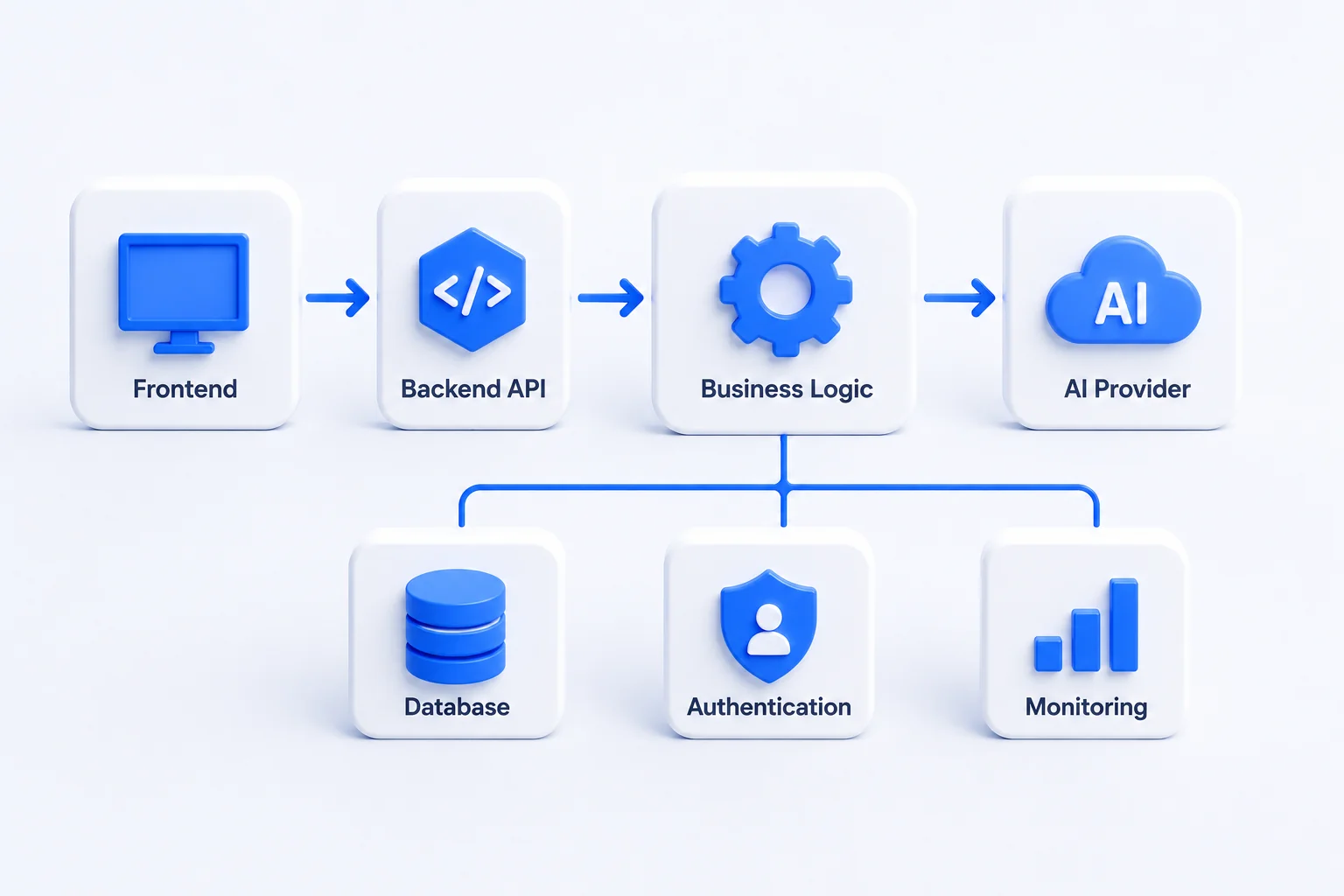
4. Build the simplest suitable architecture. "It's only an MVP" isn't an excuse for bad engineering, but an MVP doesn't need infrastructure designed for millions of users either. A practical early architecture is: Frontend → Backend API → Business Logic → AI Provider, plus a database, authentication, and monitoring. Add more components only when the product actually requires them — every component creates maintenance cost.
Output: a working end-to-end path from user input to stored, reviewable output.
Evidence to move on: the workflow runs reliably for a test user without manual intervention behind the scenes. -
5. Add essential safeguards and failure handling. Treat AI output as untrusted, control who can access what, and make sure failures are visible instead of silent. Details in the security section below.
Output: input validation, access control, and a defined fallback for when the AI is wrong or unavailable.
Evidence to move on: you can describe what happens for every major failure mode — bad input, low-confidence output, provider downtime — without guessing. -
6. Pilot with real users and measure outcomes. Get the workflow in front of the actual target users, on their real inputs, and track the metrics that matter for this product (see the cost and success-metrics section below).
Output: a pilot with a defined group of users and a running log of outcomes.
Evidence to move on: enough pilot volume that the results reflect real usage, not a handful of lucky or unlucky runs. -
7. Decide whether to iterate, stop, or scale. Use the pilot evidence, not enthusiasm or sunk cost, to decide what happens next. A checklist for this decision is at the end of the article.
Output: a documented decision and the reasoning behind it.
Evidence to move on: the decision is traceable to specific pilot results, not a hunch.
Don't Build Your Own Model Unless You Need One
Custom AI development doesn't necessarily mean training a custom model. For many AI MVPs, starting with an existing foundation model is faster and more economical — combined with application-specific prompts, proprietary data, APIs, retrieval systems, business logic, and workflow automation. This lets you validate the product before making expensive infrastructure or model-training decisions. Training a large model from scratch, fine-tuning an existing one, and training a small model for one narrow task are three different levels of investment with different justifications — none of them is the default MVP choice, and which one (if any) makes sense depends on your accuracy needs, data volume, and budget.
If real usage later shows that cost, latency, privacy, or specialized performance requires a different model strategy, you can make that decision with actual data. That said, some constraints — a hard privacy requirement, a response-time limit the workflow can't function without, a cost ceiling that would make the product unviable at any real volume — need to be accounted for from the start, not deferred until after launch. Don't defer the constraints that are already known; do defer the scaling work you don't have evidence you'll need yet.
Testing the AI Capability Before You Build Around It
Continuing the document-processing example: before building the review interface, database, and workflow around the AI, check whether the extraction itself is good enough to be worth building around.
- Select representative real examples — including messy, incomplete, or ambiguous documents, not just the clean ones that are easy to demo with.
- Define the correct output or grading criteria up front, before looking at what the model produces, so you're not unconsciously grading it on a curve.
- Hold out part of the examples for evaluation only — don't use every example to tune your prompt, or your test results will be optimistic.
- Compare the result against your current manual process or a simpler alternative. An AI system that outperforms a spreadsheet macro is a different result from one that barely beats manual review.
- Set an acceptance bar before the pilot, not after seeing results — otherwise it's easy to rationalize a bar that fits whatever the model happened to produce.
For the document-extraction example, don't rely on a single vague number like "AI accuracy." More specific, decision-useful metrics include: accuracy on the fields that actually matter for the workflow (not an average across every field, some of which may not matter much if wrong), the rate at which a human has to correct the output, how long the workflow takes end to end, and the cost per accepted output — meaning a result that passed review, not just one the model produced.
Two things are easy to over-trust here. Schema validation — confirming the model returned well-formed JSON with the right fields — only checks structure. It says nothing about whether the values are actually correct; a perfectly-formed response can still contain a wrong number. And a confidence score the model reports about its own output is not automatically a reliable probability — treat it as a signal to weigh against your own evaluation results, not as ground truth on its own.
Keep AI Behind Your Backend
Instead of connecting the frontend directly to an AI provider, prefer: Frontend → Your API → AI Layer → AI Provider. Your backend can then hold provider credentials securely, and control permissions, prompts, model selection, usage limits, logging, retries, and response validation server-side. Keeping AI behind a backend doesn't, by itself, eliminate dependency on a specific provider — but separating out the provider-specific logic into its own layer makes switching providers later cheaper, since the rest of the application isn't wired directly to one vendor's API shape. You don't need to build multi-model support on day one; you need the seam that would let you add it later without a rewrite. For more on structuring that API layer, see our guide to API-first development for SaaS.
Long-running tasks are also worth planning for early, even in a pilot with a handful of users — not just as a scaling concern. If a document takes 30 seconds to process, holding an HTTP request open for that long is fragile regardless of user count. A background job with a status the frontend can poll is often simpler to get right than trying to make a long synchronous request reliable.
Don't Build Features Users Haven't Asked For
Founders naturally think about future requirements. That can become expensive. Does the MVP really need advanced analytics, multiple AI providers, ten integrations, a mobile application, enterprise permissions, or custom reports? Before adding a feature, ask: What assumption does this help us validate? If there isn't a clear answer, it probably doesn't belong in version one. If your product may eventually need custom AI development beyond a single workflow, that's a decision worth revisiting after the MVP has real usage data — not before.
Security and Failure Handling
Avoiding overengineering doesn't mean building carelessly. Two questions are worth keeping separate: authentication (who is this user?) and authorization (what data and actions are they allowed to access?). Getting authentication right but skipping authorization is a common way for one user to end up seeing another user's documents.
Applied to the document-processing example, a short list of essentials:
- Keep provider API keys server-side — never in frontend JavaScript, where anyone can read them.
- Enforce document access control on the server: a user's request for a document should be checked against what that user is actually allowed to see, not just whether they're logged in.
- Validate file type and size before processing — don't trust the file extension or a client-reported content type alone.
- Add a timeout, a bounded number of retries, and protection against processing the same upload twice (for example, if a user double-clicks submit or a retry fires after a slow response).
- Don't log the full text of sensitive documents by default — logs often have weaker access control than the primary data store.
- Validate or review the model's output before it drives a consequential action, like updating a financial record or notifying a customer.
This is a starting list for a document-processing MVP, not a full enterprise security checklist — the right list depends on what data your workflow touches.
Cost and the Decision to Iterate, Stop, or Scale
AI products have a characteristic worth planning for early: many user interactions carry a direct, per-use cost. As a purely illustrative example — not a benchmark — suppose processing one task costs a hypothetical $0.10, and a hypothetical customer generates 1,000 tasks a month; that would put model cost alone at around $100 for that customer. That $100 reflects only the assumed per-task cost — it isn't the total cost of running the service, which also includes retries, errors, infrastructure, and any human review time. The real number for your product will depend on your actual model pricing, retry rate, and workflow.
Success metrics matter just as much as cost. Don't judge the pilot only on user growth or response latency — also look at whether people come back and use it again, what value the workflow is actually creating (time saved, errors avoided, revenue enabled), and any signal that users would pay for it, such as a willingness to upgrade or a request to expand usage.
When the pilot has run long enough to produce real evidence, work through this checklist rather than reacting to any single data point:
- Are users returning to use the workflow without being prompted to?
- Is the AI's output quality holding up on real, varied inputs — not just the examples you tested with?
- Is the cost per accepted output something the business can sustain at current or growing volume?
- Is there a specific, recurring pressure — a performance bottleneck, a blocked integration, a compliance requirement — that justifies the next piece of architecture?
- Is there evidence, not just interest, that users get enough value to keep using or paying for this?
If the answers are mostly positive, scale the specific part under pressure. If they're mixed, iterate on the workflow before expanding it. If the core assumption didn't hold, that's a valid outcome of an MVP too — it's cheaper to learn that now than after building the full platform.
Conclusion
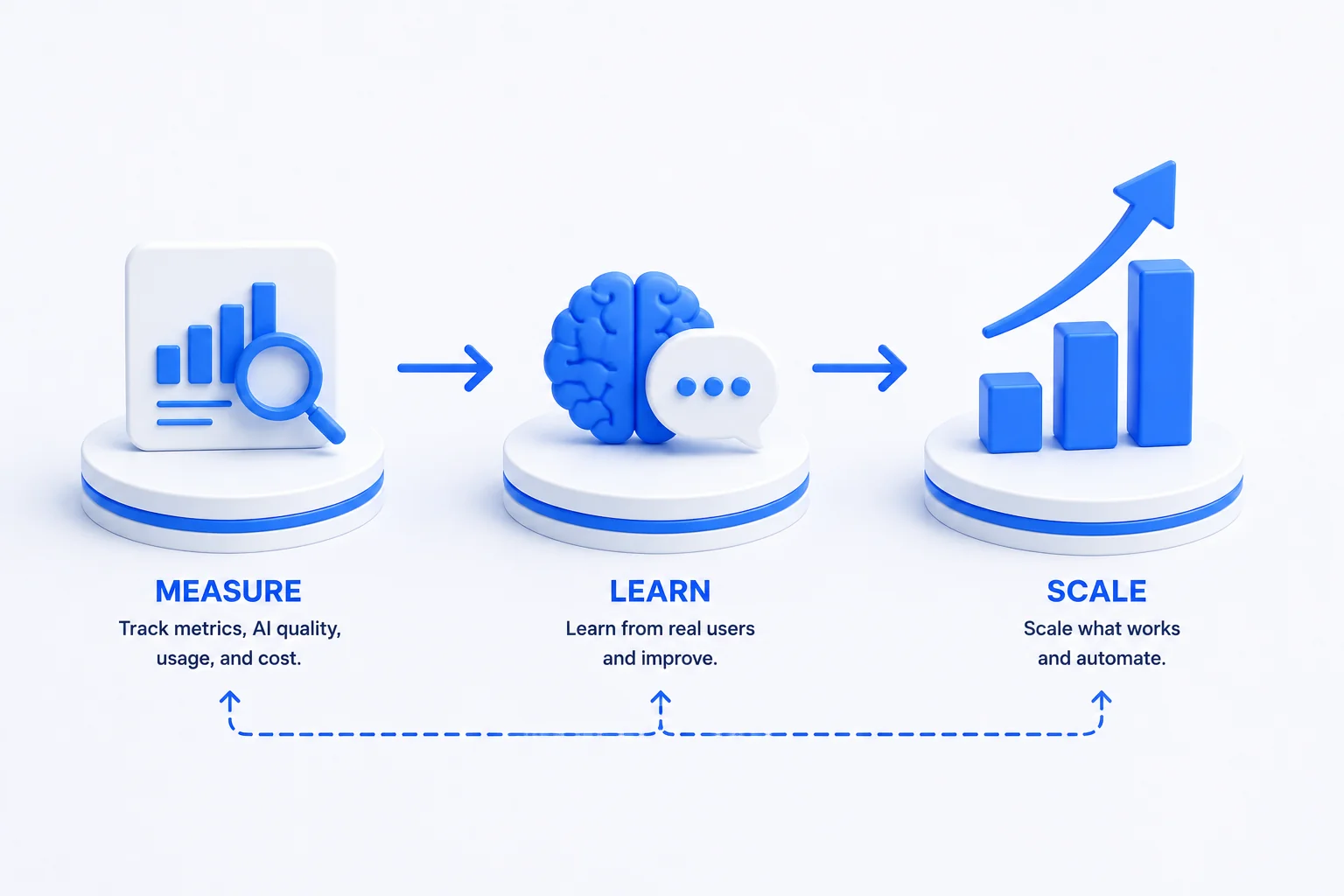
The purpose of an AI MVP isn't to build a smaller version of your final product. It's to discover what the final product should become. Start with the riskiest assumption. Build one complete workflow. Test the AI capability on real examples before building around it. Keep the architecture simple without making it disposable. Measure quality, usage, and cost from the beginning. Then let real users tell you where the engineering investment should go next.
The teams that build successful AI products aren't necessarily the ones that build the most in version one. They're often the ones that learn the fastest without creating a technical mess along the way.
At Seawolf Intelligent Computing, we build focused AI MVPs, APIs, and SaaS products with a production mindset — keeping the first version lean while creating a clear path for the architecture to evolve. Have an AI product idea? Discuss your AI MVP and we'll help determine what version one actually needs — and what it doesn't.
Frequently Asked Questions
What is the difference between an AI prototype and an AI MVP?
A prototype is built to test feasibility or one specific assumption — for example, whether a model can perform a task at all. An MVP is built to collect evidence from real usage and test whether the product creates enough value for people to keep using it; that evidence can come back positive or negative. A prototype might be a notebook with a good result on a handful of examples. An MVP is a functional workflow used by real people, with whatever authentication, error handling, and data controls that specific workflow requires, and something measurable at the end.
How do I decide which assumption to test first?
Identify the assumption that, if wrong, would make the entire product not worth building. For most AI products, that's either "can the AI perform this task accurately enough?" or "will users actually pay for this?" Test the most dangerous assumption first, before investing in supporting features. Every week spent building dashboards before validating core accuracy is a week of avoidable risk.
Should we use an existing AI model or build our own?
For most MVPs, starting with an existing foundation model is the faster and cheaper way to get to a testable product — but it depends on the problem and your constraints. Training a large model from scratch, fine-tuning an existing model, and training a small model for one narrow task are different levels of investment, not interchangeable options, and each is justified by different accuracy, data, and budget situations. Existing foundation models combined with good prompting, retrieval, and application logic can handle many AI product use cases, though not all of them. Switch strategies when real usage data — or a known constraint you already have, like a hard accuracy or privacy requirement — gives you a specific reason to.
What production basics do we actually need in an MVP?
Authentication (users should only see their own data), authorization (checking what a logged-in user is actually allowed to access, not just that they're logged in), input validation (don't trust incoming data), error handling for AI provider failures, basic logging so developers can diagnose issues, and appropriate data protection for any sensitive information. You don't need Kubernetes or a distributed system. You need enough engineering discipline to safely learn from real users without creating a security or reliability incident.
How do we know when the MVP is ready to scale?
Scale in response to real pressure, not hypothetical future demand — but a few constraints, like a hard privacy requirement or a response-time limit the workflow can't function without, need to be handled from the start rather than deferred. If users are experiencing performance problems, optimize the bottleneck. If AI costs are becoming significant, explore caching or smaller models. If a specific integration is blocking adoption, build it. Let actual product requirements drive architectural decisions — not architecture diagrams drawn before you have users.