SERVICES
What we do
Three service lines. All grounded in the same principle: software that works in production is the only kind worth building.
We design and build AI systems and APIs for companies that need engineering they don't have internally. We don't hand you a strategy deck — we write the code, design the architecture, and ship the software. Everything we build for clients, we've also built for ourselves.
01AI Software Development
Start a project ↗We build AI-powered applications for companies that need intelligent systems, not proof-of-concept demos. That means end-to-end engineering: problem definition, data architecture, model selection or training, integration, deployment, and monitoring.
What we do
- Custom AI application design and development
- Machine learning model integration (open-source and commercial models)
- Data pipeline architecture and implementation
- AI feature development inside existing products
- Model evaluation, fine-tuning, and performance optimization
- Inference infrastructure and serving layer setup
- AI system monitoring and observability
How we work
We start with the problem, not the model. Most AI projects fail because teams pick a technique before they understand the data or define what "working" actually means. We spend the first phase of every engagement mapping the problem precisely: what decisions the system needs to support, what data exists, what accuracy threshold makes the feature useful, and what happens when the model is wrong.
From there we move to a lean prototype — not to impress, but to validate assumptions fast. Production build follows: clean code, proper error handling, tested inference paths, logging that makes debugging tractable.
Outcomes clients get
- An AI system that does the specific thing it was designed to do, reliably
- Architecture documentation so your team can maintain and extend it
- Monitoring setup so you know when something drifts
- A codebase your engineers can read
What makes this different
We don't ship black boxes. Every AI system we build includes an explicit failure-mode plan — what happens when the model's confidence is below threshold, who or what takes over, and how the system signals uncertainty to downstream processes. We set explicit go/no-go criteria before we build. If the prototype doesn't clear the bar, we know before we've committed a full engineering cycle.
02API Development
Start a project ↗APIs are infrastructure. Bad ones become technical debt that limits every product decision you make for years. We design APIs that are correct from the start: clean contracts, predictable behavior, sensible versioning, and documentation that developers actually read.
What we do
- RESTful and query-based API design and implementation
- API-first architecture planning
- Authentication, authorization, and API key management
- Rate limiting, throttling, and abuse prevention
- Webhook design and event-driven integration
- API gateway setup and configuration
- Structured API specification and developer documentation
- Integration testing and contract testing
How we work
We design the API contract before we write the implementation. We use a structured API specification as the primary design artifact. Clients review the spec, ask questions, and sign off before implementation starts. Changes at the design stage cost nothing. Changes after integration has begun cost a lot.
Implementation follows the spec. Every endpoint has integration tests. Error responses are structured consistently. Pagination, filtering, and versioning are handled the same way across the whole API, not endpoint by endpoint.
Outcomes clients get
- An API other developers enjoy using
- Complete, structured API documentation
- A versioning strategy that lets you ship new features without breaking existing consumers
- Test suite that catches regressions before they reach production
What makes this different
Most teams skip contract-first design, which is why so many APIs have inconsistent naming, surprising error responses, and endpoints that do three things at once. We enforce this discipline on every engagement because the cost of skipping it always shows up later — and it always costs more than the time saved upfront.
03Resource Augmentation
Start a project ↗We embed experienced engineers directly into software teams that need to move faster or fill a specific skill gap. No ramp-up overhead, no process mismatch — our engineers work inside your stack, your tools, and your workflow from day one.
What we provide
- Senior engineers available full-time or part-time
- AI and ML specialists for teams without in-house expertise
- Backend and API engineers for high-throughput or complex integrations
- Short-term capacity for product sprints or release cycles
- Long-term embedded roles for sustained team extension
How we work
We treat your codebase as ours. Before writing a line of code, we read the architecture, understand the conventions, and ask the right questions. We don't impose our preferences on an existing system — we follow what's already working and flag what isn't.
Communication is async-first and written. We document decisions, not just outcomes, so your team stays informed and in control even when we're heads-down building.
Outcomes clients get
- Engineering velocity without the cost of a full-time hire
- Specialists on demand — no months-long recruiting cycles
- Clean handoff when the engagement ends: documented code, no tribal knowledge locked away
- A team that integrates, not a vendor that invoices
What makes this different
Most augmentation arrangements fail because the embedded engineers don't understand the product context. We insist on a proper onboarding call, read the product roadmap, and align on priorities before starting. The result is engineers who make decisions your team would make — not engineers who need constant direction.
All three services, applied to our own product
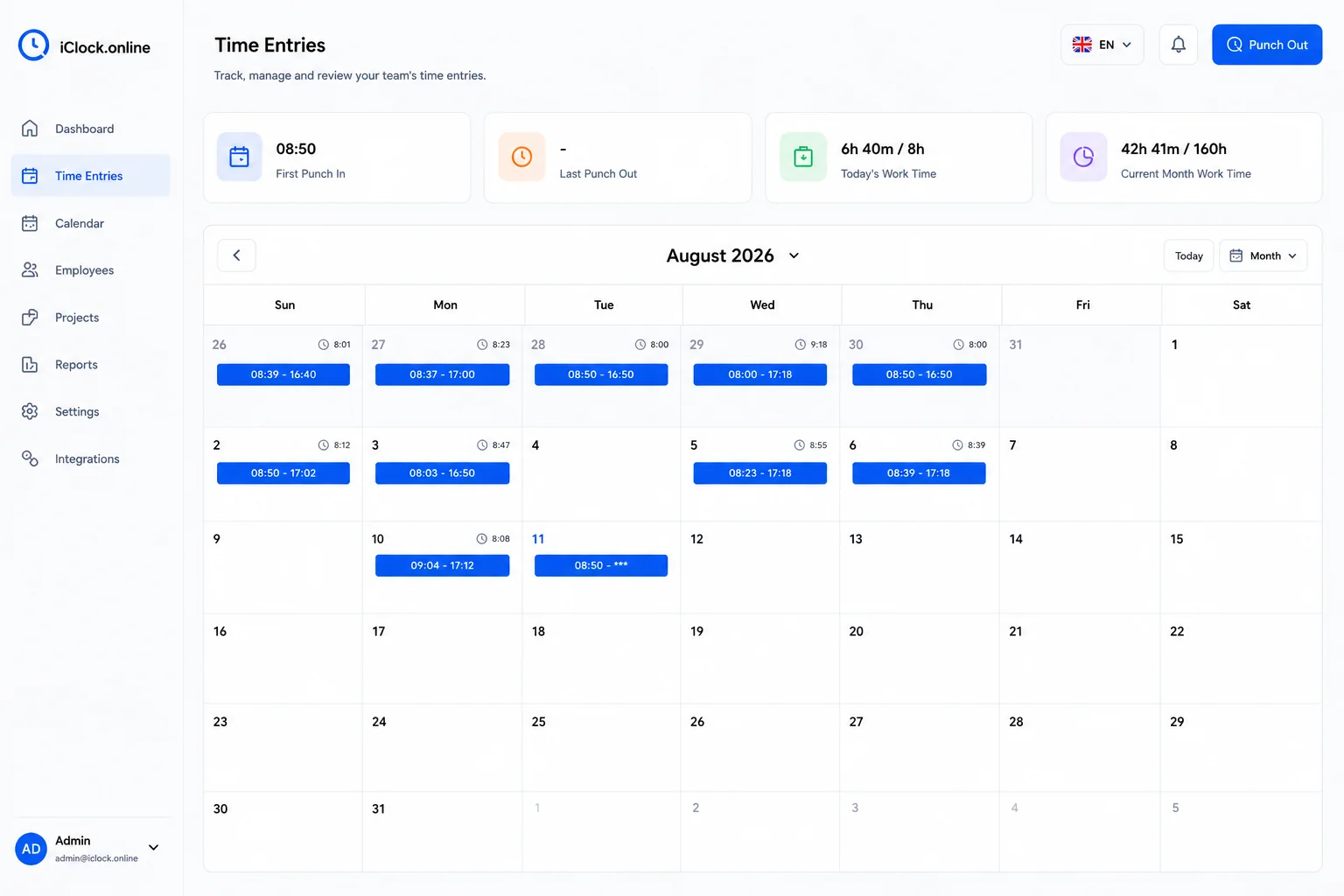
iClock.online is the clearest demonstration of how we work — the AI-powered attendance engine, the API layer, the admin interface, and the infrastructure, all built and operated by us.
See iClock.online ↗LIVE REFERENCE
iClock.online
When a client asks what our AI or API work looks like in practice, we point them here. A live system we maintain, scale, and improve every day.
- ✓AI anomaly detection engine
- ✓API-first architecture
- ✓Third-party payroll integrations
- ✓Operated daily by our team