
ARTICLE 07 · 13 MIN READ
IVR Testing Software: Call Flows, Speech, and Caller Experience
For many businesses, the phone is still one of the most important ways customers reach them, and most calls pass through an Interactive Voice Response (IVR) system before a caller talks to a person. A well-designed IVR gets callers to the right place quickly; a poorly designed one creates exactly the opposite experience. Testing that experience systematically — rather than relying on occasional manual checks — is what IVR testing software is for.
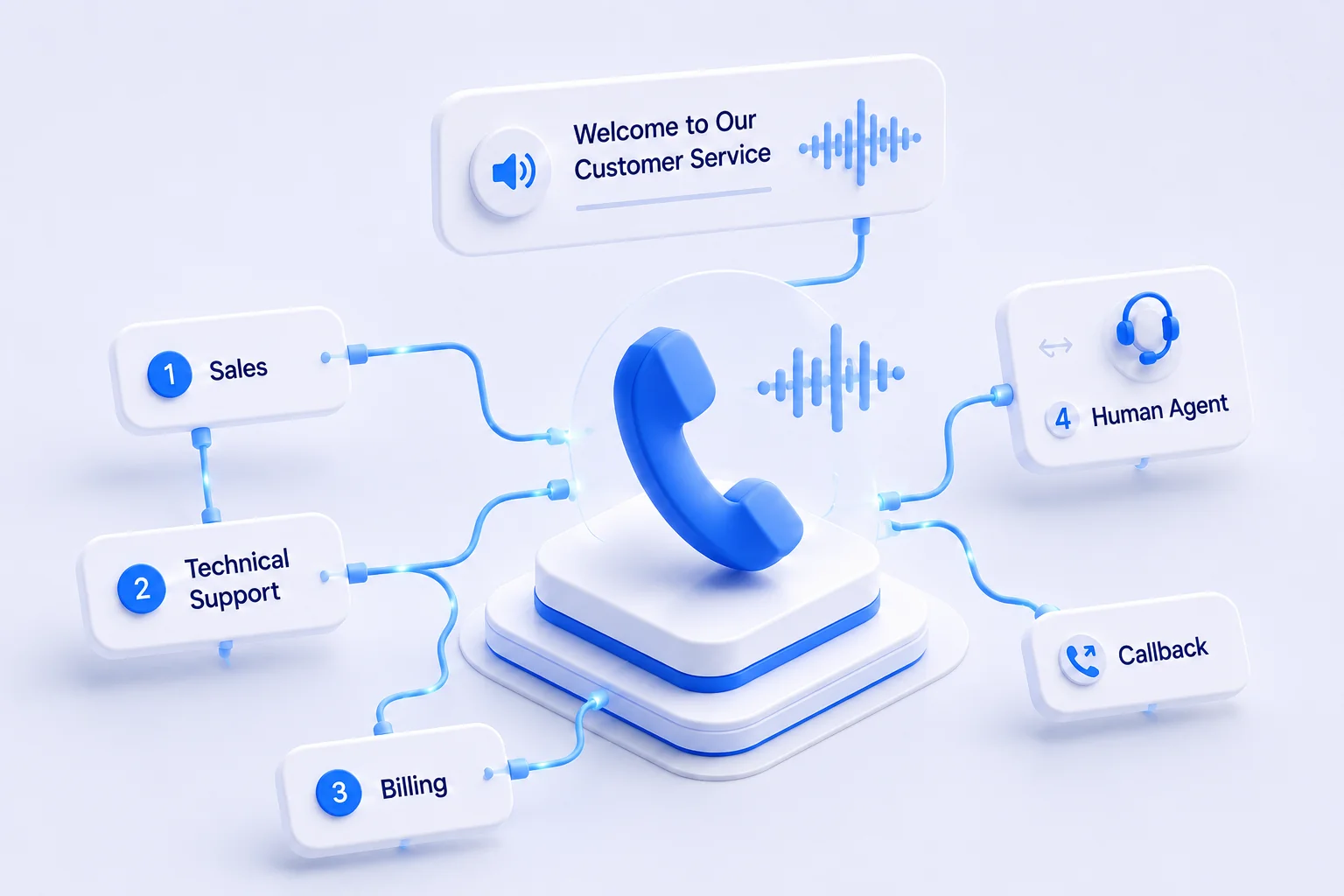
Why IVR Testing Matters
An IVR may look simple from the outside, but the underlying call flow tends to grow more complex as a business grows — multiple menu levels, different departments, business-hour rules, regional routing, transfers to live agents, authentication steps, error handling, and menu paths that get added and rarely removed. As those components accumulate, manually testing every possible route becomes impractical, and a small change to one menu can quietly break something elsewhere in the flow.
Automated IVR testing addresses this by calling and evaluating an IVR on a schedule or on demand, then producing a report that highlights discrepancies and areas for improvement — turning IVR quality from an occasional manual audit into a repeatable process.
What Is IVR Testing Software?
RoastMyIVR is an automated IVR testing platform: an organization provides its IVR number, the platform places test calls and evaluates the flow, and it returns a report rather than requiring someone to manually walk every path themselves. Its core areas are call-flow documentation, discrepancy detection, speech recognition testing, best-practice recommendations, regional testing, and automated reporting, with API access for triggering reports from a build pipeline.
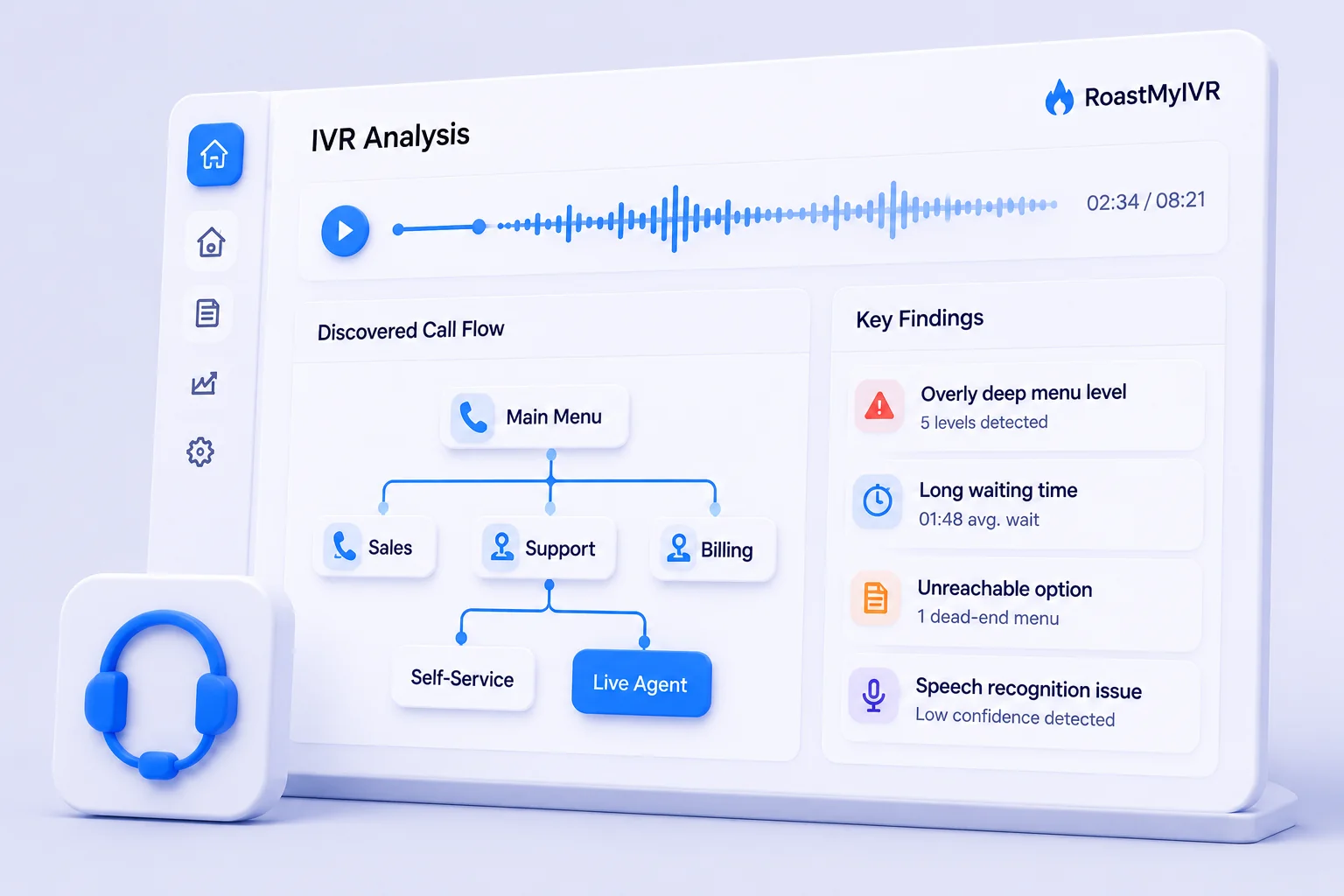
What "Coverage" Actually Depends On
It's worth being precise about claims like "tests every path" or "replaces manual testing entirely." In practice, how much of an IVR gets meaningfully covered by a given test run depends on several things at once: which scenarios were actually configured, what test data and inputs were used, whether authentication-gated paths were included, whether the test ran during or outside business hours, and what access the tester had to reach every branch (including rarely used or hidden menu options). A test suite that covers the main call paths well may still miss an edge case that only appears under a specific combination of those factors — that's a scope question to ask directly, not something a general claim of "automated testing" answers on its own.
Language Support: Testing vs. Product Capability
RoastMyIVR's own documentation is specific here and worth quoting directly as the standard: it currently supports English IVRs, with multilingual speech recognition support on the roadmap. That's a clear, current statement — use it as-is rather than assuming broader coverage.
It's also worth keeping two separate facts separate, in either language version of this article: the fact that this article (or RoastMyIVR's own interface) is available in Armenian does not mean the underlying product can test Armenian-language IVR call flows. Website translation and product language capability are two different things, and conflating them — in English or in Armenian — would misrepresent what's actually supported.
A Practical Test Scenario Table
The table below illustrates the kind of scenarios an IVR test plan typically covers. These are examples of test design, not a confirmed list of everything a specific platform runs automatically out of the box — check current scope directly before assuming full support for every row.
| Scenario | Expected result | Pass criteria |
|---|---|---|
| Valid menu selection | Caller reaches the intended destination for that option | Call routes to the correct department or queue within an expected time |
| Invalid input | System recognizes the input as invalid and responds appropriately | Caller receives a clear error prompt, not a dead end or silent drop |
| No input entered | System handles timeout gracefully | Caller is re-prompted or routed to a fallback, not disconnected |
| Call outside business hours | Caller hears correct after-hours messaging or routing | After-hours path matches configured business-hour rules |
| Transfer to expected destination | Live-agent transfer reaches the correct queue or department | Transfer target matches the documented routing design |
| Speech recognition in a defined scenario | Spoken input is correctly recognized for a specific supported language | Recognized intent matches the caller's actual spoken request |
A Hypothetical Sample Report
To illustrate what a test report might communicate — without using any real customer phone number or sensitive data — consider a simplified, hypothetical example:
Path tested: Main menu → "Billing" → "Dispute a charge."
Expected: Caller reaches a billing-disputes queue within two menu selections.
Observed: Caller is routed through an intermediate "Account Services" menu not shown in the current documentation, adding one extra step before reaching the correct queue.
Why it matters: An undocumented extra step increases average call-handling time and creates a mismatch between the actual flow and what support staff believe it is.
Suggested follow-up: Confirm whether the extra step is intentional; if not, review the routing rule and update the documented call-flow diagram.
Menu Latency, Route Time, and Queue Wait
"Slow IVR" can mean several different things, and it's worth separating them because they have different causes and fixes: how long the system takes to respond to a menu selection, how long it takes to route a call from the main menu to its final destination, and how long a caller waits in an agent queue after routing is complete. A test can surface where in that chain a delay is happening — but running the test itself doesn't reduce wait time or guarantee adequate staffing; those require separate operational changes based on what the test reveals.
It's also worth distinguishing structured call-flow testing from load testing or continuous uptime monitoring. Testing a flow's logic and timing on a sample of calls is a different exercise from testing how a system behaves under high concurrent call volume, or monitoring it continuously for outages — a platform built for one isn't automatically doing the other.
API Access and Confidentiality
RoastMyIVR documents an API key that can trigger IVR reports from a build pipeline — useful for auditing IVR changes before they go live as part of a broader release process. It's worth being precise about what that does and doesn't include: having an API to trigger a report is not the same as having an automatic pass/fail gate wired into CI/CD. Turning a report into a build-blocking check requires defining pass/fail thresholds and interpreting results — that's integration work for the team adopting it, not something that ships pre-configured. Current documentation doesn't specify exact endpoints, parameters, report generation time, or call-volume limits; confirm those directly if you're planning a pipeline integration.
On confidentiality: RoastMyIVR states that report data is confidential and accessible only to the customer. That's a vendor-stated position rather than an independently verified policy — if data retention period, who at the vendor can access report contents, or call-recording and deletion practices matter for your compliance requirements, ask for that in writing rather than relying on a marketing statement alone. Any test numbers or environments used should be ones your organization is actually authorized to test against — this article does not recommend placing real calls to unauthorized numbers.
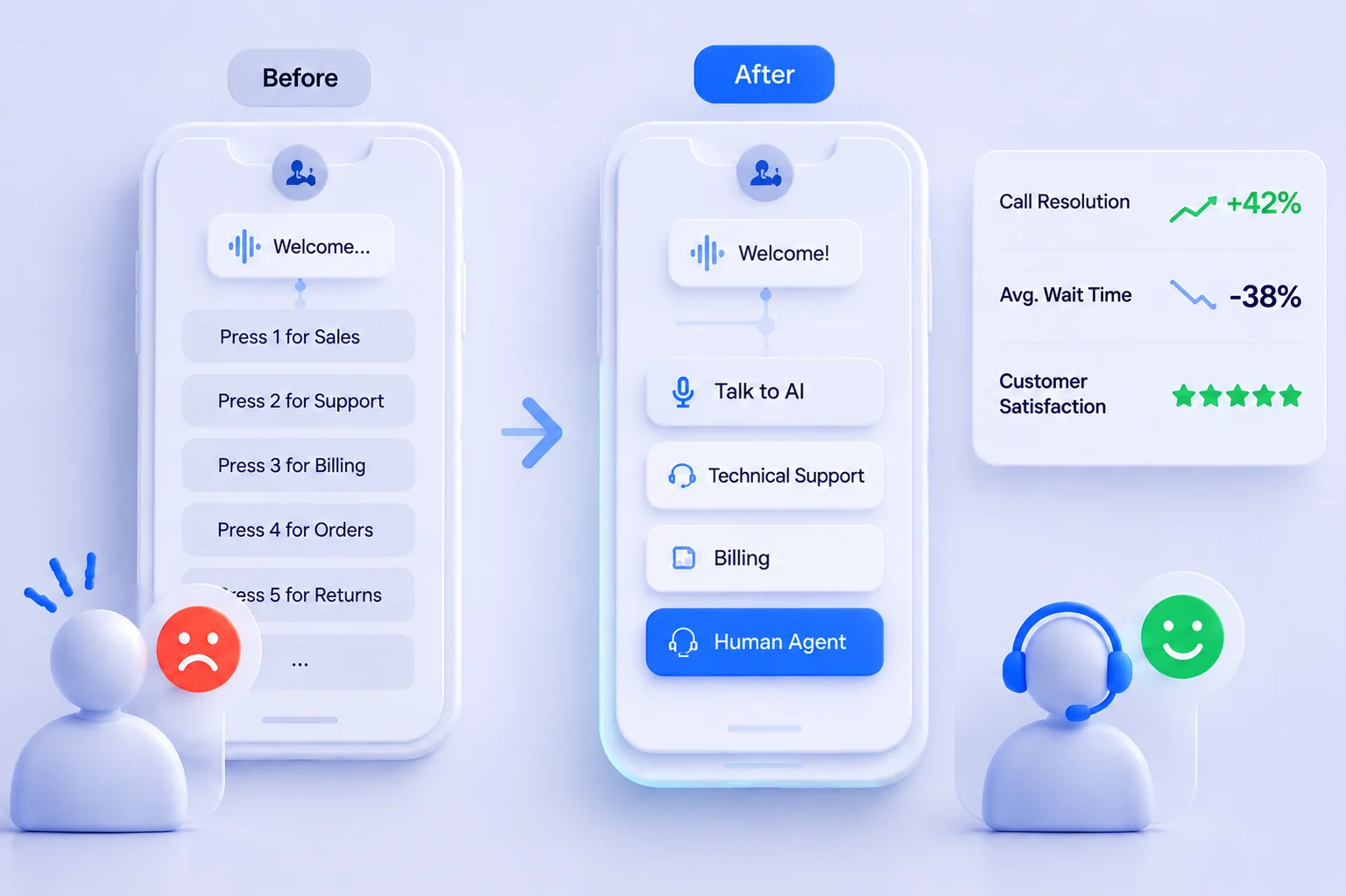
Who Uses IVR Testing
Customer Service Teams
Identify unnecessary steps in the path customers take before reaching an agent.
Contact Centers
Evaluate complex call-routing structures at a scale manual testing can't practically cover.
Technology Teams
Trigger automated reports as part of existing release and quality-assurance workflows.
Operations Teams
Use evaluation reports to prioritize which parts of the caller journey to fix first.
Beyond the automated report itself, RoastMyIVR also offers IVR consulting — engineers who redesign and optimize a flow after an audit — and IVR hosting, where the team can build and host a replacement IVR. That's a genuine path from assessment to implementation, distinct from the automated testing product itself.
Conclusion
IVR testing software turns call-flow quality from an occasional manual spot-check into a repeatable process: test, identify discrepancies, optimize, and test again. The value of that process depends on scenario coverage, test data, and access being clearly scoped — not on treating "automated" as a synonym for "complete."
RoastMyIVR is part of Seawolf's product portfolio, focused specifically on automated IVR evaluation, documentation, and reporting, with consulting and hosting available for organizations that want help implementing the changes a report surfaces.
Curious how your own IVR would score? Explore RoastMyIVR →
Frequently Asked Questions
Does RoastMyIVR test IVRs in languages other than English?
As documented, the platform currently supports English IVRs, with multilingual speech recognition support on the roadmap. If you need a specific additional language, confirm current status and timeline directly with the team rather than assuming it's already covered.
Does an Armenian-language version of this article or the RoastMyIVR site mean it can test Armenian IVR calls?
No — those are separate facts. A page being available in Armenian is a website translation choice; it says nothing about which spoken languages the underlying IVR-testing product can evaluate. As of this writing, the documented product capability covers English IVRs, regardless of which language you're reading this in.
Can I wire RoastMyIVR into CI/CD as an automatic pass/fail gate?
RoastMyIVR provides an API key to trigger reports from a build pipeline, which is a useful building block for this. But turning that into an automatic pass/fail gate — defining thresholds, interpreting report output, and failing a build on specific conditions — is integration work you design and implement, not something that comes pre-configured.
Does testing an IVR guarantee shorter wait times or correct staffing?
No. Testing can reveal where delays occur — in menu response, routing, or queue wait — but fixing wait times or staffing levels requires separate operational changes based on what the test uncovers. The test surfaces the problem; it doesn't solve it by itself.