
ARTICLE 02 · 7 MIN READ
How to Build an AI MVP Without Overengineering It
Most AI products should start smaller than their founders imagine. When you have a strong idea, it's tempting to think about the complete platform: AI agents, automation, analytics, integrations, custom infrastructure, and every feature users might eventually need. That's usually the wrong place to start.
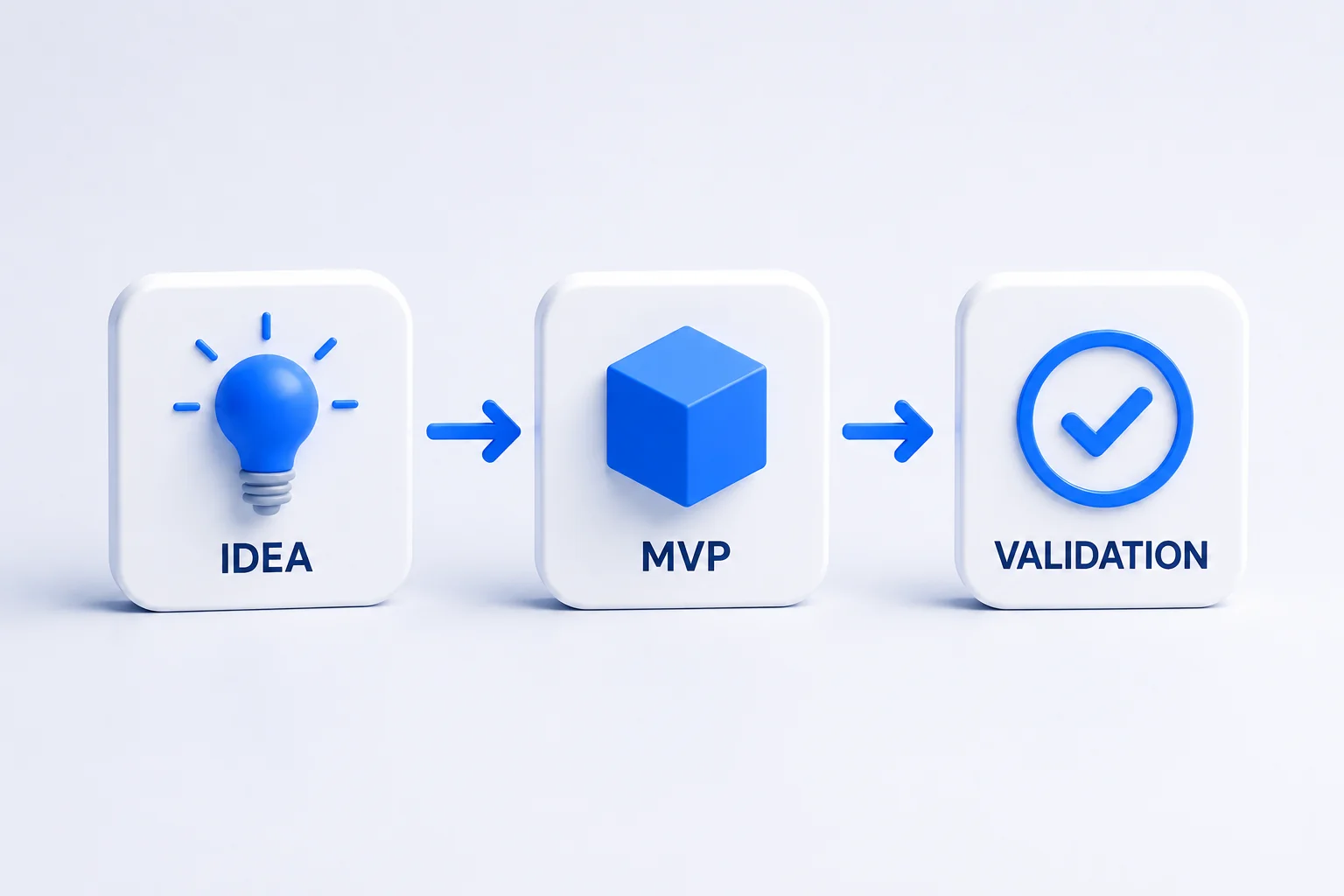
An AI MVP has one job: Prove that the core product creates enough value to justify building more.
Build too much, and you spend months engineering assumptions that haven't been validated. Build too little, and you end up with a demo that works during a presentation but tells you almost nothing about how real users will interact with the product. A good AI MVP sits somewhere in between.
What Is an AI MVP?
An AI MVP — Minimum Viable Product — is the smallest functional version of an AI-powered product that can test its most important assumptions with real users. The key word is functional. A prototype might prove that an AI model can perform a task. An MVP should prove that users actually want the product built around that capability.
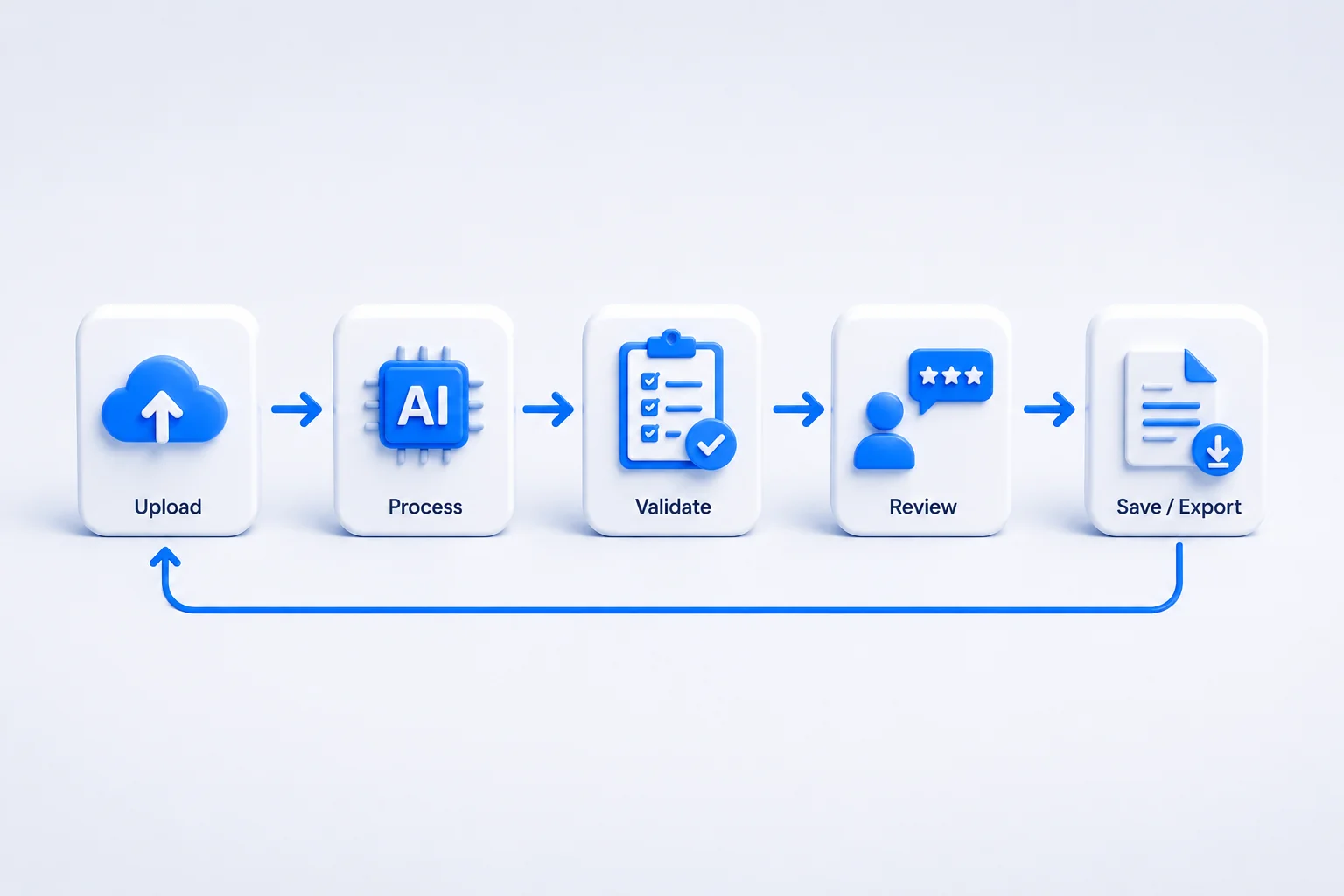
Imagine an AI document-processing product. A prototype might allow someone to upload a PDF and receive an AI-generated result. An MVP might support a complete workflow: Upload → Process → Validate → Review → Save. It may also include authentication, a database, basic error handling, and a usable interface. It doesn't need every future feature. It needs enough product around the AI to test whether the idea creates real value.
Start With the Riskiest Assumption
Before writing code, identify what could make the entire product fail. For an AI product, that might be: Can the AI perform the core task accurately enough? But it could also be: Will customers pay for this? Can we access the required data? Will users trust the AI output? Does the workflow save enough time to matter? Can we operate it at an acceptable cost?
Your MVP should test the most dangerous assumption first. If your business depends on extracting information from complex documents with high accuracy, don't spend weeks building dashboards before proving that extraction quality is achievable. Build the experiment that gives you the most important answer. Then move to the next question.
Build One Complete Workflow
One of the most common MVP mistakes is building ten features at 20% quality. Instead, build one valuable workflow from beginning to end. Suppose you're developing an AI system for processing business documents. Rather than supporting multiple document types, advanced analytics, team collaboration, and ten integrations, version one might support a single high-value document type. But the workflow should actually work:
Upload Document → Extract Information → Validate Required Fields → Flag Uncertain Results → User Reviews Output → Save or Export
Now you have something a real user can test. You can measure how much time it saves, identify where the AI fails, observe how users behave, and discover what they actually want next. That information is far more valuable than another month of speculative development.
Don't Build Your Own Model Unless You Need One
Custom AI development doesn't necessarily mean training a custom model. For most AI MVPs, starting with existing models is faster and more economical. You can combine them with application-specific prompts, proprietary data, APIs, retrieval systems, business logic, and workflow automation. This allows you to validate the product before making expensive infrastructure or model-training decisions.
If real usage later shows that cost, latency, privacy, or specialized performance requires a different model strategy, you can make that decision with actual data. Don't solve a scaling problem before you have users.
Keep the Architecture Simple — But Not Disposable
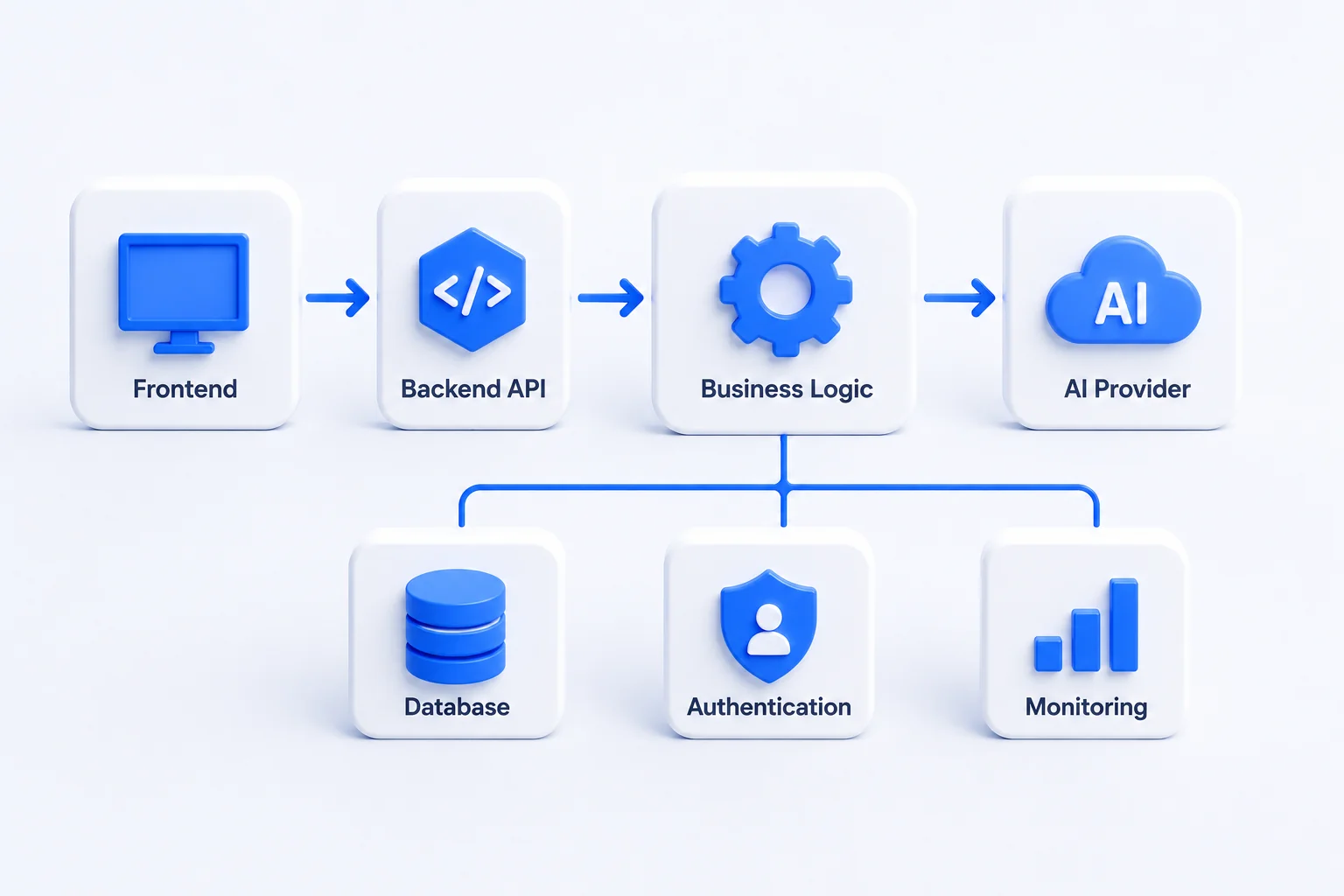
"It's only an MVP" isn't an excuse for bad engineering. But an MVP doesn't need infrastructure designed for millions of users either. A practical early architecture might be: Frontend → Backend API → Business Logic → AI Provider, plus a database, authentication, and monitoring. Add more components only when the product actually requires them. Every component creates maintenance cost. Complexity should be earned.
Keep AI Behind Your Backend
Instead of connecting the frontend directly to an AI provider, prefer: Frontend → Your API → AI Layer → AI Provider. Your backend can then control authentication, permissions, prompts, model selection, usage limits, logging, retries, and response validation. It also prevents the product from becoming unnecessarily dependent on one model provider. AI technology changes quickly. The model you use for the MVP may not be the model you want six months later. Your application should own the workflow. The model should remain a replaceable component.
Don't Build Features Users Haven't Asked For
Founders naturally think about future requirements. That can become expensive. Does the MVP really need advanced analytics, multiple AI providers, ten integrations, a mobile application, enterprise permissions, or custom reports? Before adding a feature, ask: What assumption does this help us validate? If there isn't a clear answer, it probably doesn't belong in version one. The goal is to reach real users before assumptions become expensive software.
But Don't Ignore Production Basics
Avoiding overengineering doesn't mean building carelessly. If real users will interact with the MVP, several fundamentals still matter: authentication (users should only access information they're authorized to see), input validation (incoming data should never be blindly trusted), error handling (AI providers and external APIs will eventually fail), logging (developers need enough information to diagnose problems), basic monitoring (you should know when errors, latency, or costs increase), and data protection (sensitive customer information needs appropriate controls from the beginning). You don't need enterprise infrastructure on day one. You need enough engineering discipline to safely learn from real users.
Treat AI Outputs as Untrusted
AI introduces something traditional software teams don't always expect: the output can look correct and still be wrong. For important workflows, your application may need structured output validation, deterministic business rules, confidence thresholds, human review, and fallback behavior. Imagine AI extracting payment information from an invoice. The system shouldn't automatically assume every generated value is correct — it could validate required fields, compare totals, check formats, and route uncertain cases for human review. The AI should be part of the system. It shouldn't be the entire system.
Measure Cost From Day One
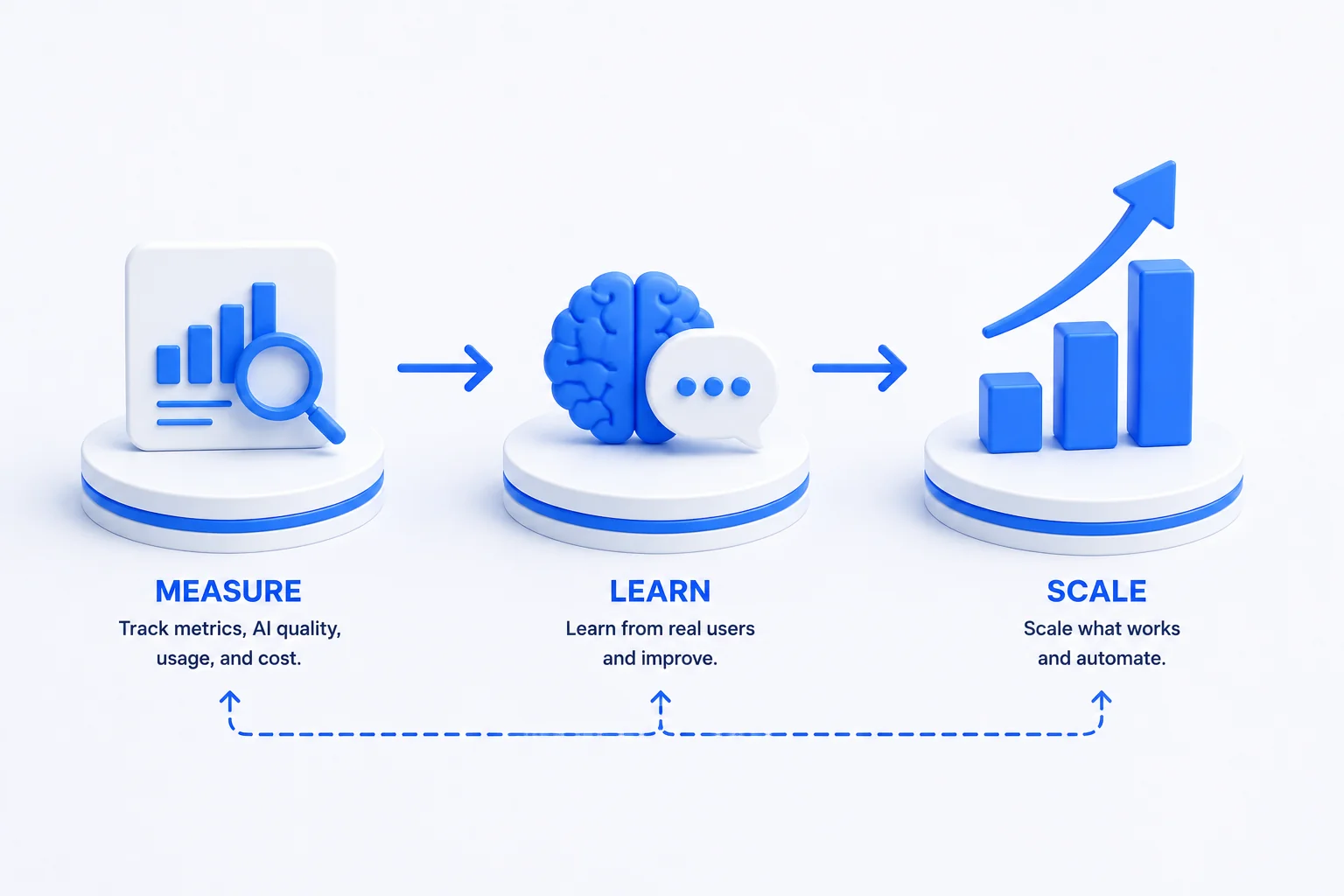
AI products have another unusual characteristic: every user interaction can have a direct cost. Model inference, embeddings, API calls, databases, and background processing all contribute to operating expenses. You don't need sophisticated cost infrastructure for an MVP, but you should be able to answer: How much does one successful workflow cost? Suppose processing one task costs $0.10 and a typical customer generates 1,000 tasks per month. That information matters when deciding pricing, margins, and whether optimization is necessary. Optimize later. Measure now.
Define What Success Looks Like
An MVP is an experiment. Experiments need measurable outcomes. Depending on the product, useful metrics could include percentage of tasks successfully automated, time saved per workflow, AI accuracy, weekly active users, customer retention, cost per completed workflow, paid conversions, or human interventions required. Avoid vanity metrics. A thousand registrations don't mean much if nobody returns. Measure whether the product solves the problem it was designed to solve.
When Should You Scale?
Scale when reality gives you a reason. Users experience performance problems? Optimize the bottleneck. AI costs become significant? Consider caching, model routing, or smaller models. Customers need a specific integration before adopting? Build that integration. Background tasks overwhelm the application? Introduce dedicated workers or queues. Enterprise customers require stronger permissions? Expand the authorization model. This keeps architecture connected to actual product requirements instead of hypothetical future problems.
Conclusion
The purpose of an AI MVP isn't to build a smaller version of your final product. It's to discover what the final product should become. Start with the riskiest assumption. Build one complete workflow. Use existing AI capabilities where they make sense. Keep the architecture simple without making it disposable. Measure quality, usage, and cost from the beginning. Then let real users tell you where the engineering investment should go next.
The teams that build successful AI products aren't necessarily the ones that build the most in version one. They're often the ones that learn the fastest without creating a technical mess along the way.
At Seawolf Intelligent Computing, we build focused AI MVPs, APIs, and SaaS products with a production mindset — keeping the first version lean while creating a clear path for the architecture to evolve. Have an AI product idea? Tell us the core problem you're trying to solve. We'll help determine what version one actually needs — and what it doesn't.
Frequently Asked Questions
What is the difference between an AI prototype and an AI MVP?
A prototype proves that an AI model can perform a specific task. An MVP proves that users actually want the product built around that capability. A prototype might be a Jupyter notebook with a good accuracy number. An MVP is a functional workflow with real users, authentication, error handling, and something measurable at the end.
How do I decide which assumption to test first?
Identify the assumption that, if wrong, would make the entire product not worth building. For most AI products, that's either "can the AI perform this task accurately enough?" or "will users actually pay for this?" Test the most dangerous assumption first, before investing in supporting features. Every week spent building dashboards before validating core accuracy is a week of avoidable risk.
Should we use an existing AI model or build our own?
For an MVP, use an existing model. Building a custom model requires large labeled datasets, significant compute, and ongoing retraining infrastructure — costs that are hard to justify before you've validated the product. Existing foundation models combined with good prompting, retrieval, and application logic can handle the majority of AI product use cases. Switch strategies when real usage data gives you a specific reason to.
What production basics do we actually need in an MVP?
Authentication (users should only see their own data), input validation (don't trust incoming data), error handling for AI provider failures, basic logging so developers can diagnose issues, and appropriate data protection for any sensitive information. You don't need Kubernetes or a distributed system. You need enough engineering discipline to safely learn from real users without creating a security or reliability incident.
How do we know when the MVP is ready to scale?
Scale in response to real pressure, not hypothetical future demand. If users are experiencing performance problems, optimize the bottleneck. If AI costs are becoming significant, explore caching or smaller models. If a specific integration is blocking adoption, build it. Let actual product requirements drive architectural decisions — not architecture diagrams drawn before you have users.